 Call us now:
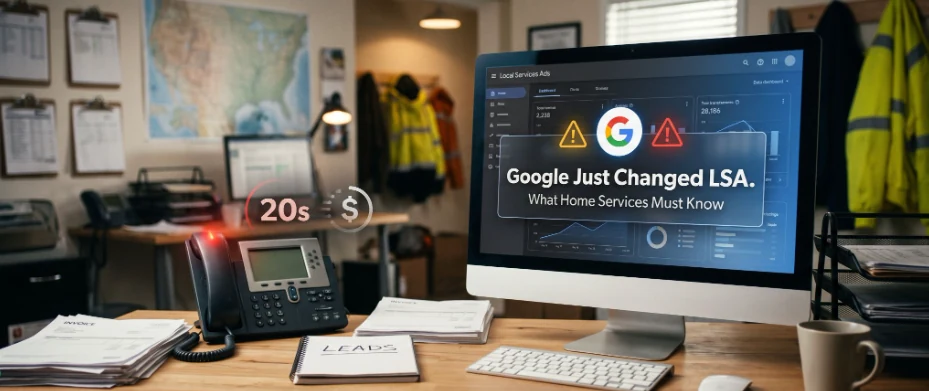
Here is why every home service business should pay attention.
Google made two changes this month that every home service business running Local Services Ads needs to understand, not panic about.
Understand?
Because neither one of these changes is going to destroy your business, but both of them should make you rethink how much of your business depends on Google.
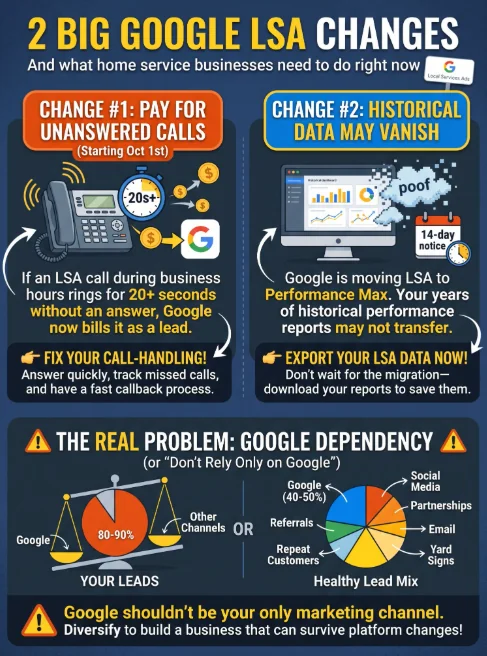
Change #1: You Can Now Pay for Calls You Never Answered
Starting October 1st, Google changed how it bills Local Services Ads.
If someone calls your business during your listed business hours and waits more than 20 seconds without reaching someone, Google can count that as a billable lead.
Read that again.
You can PAY for a lead you never actually talked to.
The phone rings, nobody answers, or the customer hangs up.
Google says, “Thanks. We’ll take it from here.”
And by “take it from here,” I mean take money from your account.
Now, before you start yelling at Google, think about the bigger issue.
Why didn’t someone answer the phone?
If you are spending money generating phone calls, answering those calls has to become one of the most important jobs inside your business.
Marketing without answering the phone is like spending money filling a swimming pool with the drain open.
You are creating the opportunity and then letting it disappear.
So the first action item is simple:
Fix your call-handling process.
Someone needs to answer.
If they cannot answer, someone needs to call back quickly.
You need tracking. You need accountability. You need to know exactly what happens when a lead calls your business.
Because now missing the call might cost you twice. You lose the customer AND you pay for the privilege.
Change #2: Your Historical LSA Data Could Disappear
Google is also moving Local Services Ads into Performance Max.
During that transition, your historical LSA performance reports may not move with your account.
Gone. Poof.
Years of information you may have used to understand lead costs, performance, trends, and results could disappear unless you export the data before your migration date.
Google reportedly gives advertisers about 14 days notice.
That sounds like plenty of time until you are running crews, selling jobs, answering customers, fixing equipment, dealing with employees and trying to remember if you ate lunch.
Fourteen days goes by fast.
So action item number two:
Export your LSA data.
Do not wait.
If Google gives you a migration date, download your historical reports and save them somewhere you control.
Google owns the platform. You should own your data.
But These Changes Are Not Really the Big Story
Here is what business owners need to understand.
Google changing LSA is not the problem. Depending almost completely on Google for leads is the problem.
For years I have watched home service businesses build their entire marketing plan around Google.
Google Ads. Google Maps. SEO. Local Services Ads.
And somebody eventually says, “At least we are doing Google.”
Okay. But that is not a marketing strategy. That is a traffic source. There is a difference.
Google has been an incredible source of leads because people searching there usually have intent.
Someone searching “plumber near me” probably needs a plumber. Someone searching “roofing company” probably is not researching the history of roofers. They want someone to replace or repair a roof.
That intent makes Google powerful.
But marketing changes. Customer behavior changes. Platforms change. Costs change.
And now AI and LLM-driven search are changing how people discover businesses.
That means the efficiency you received from Google two years ago is not guaranteed today. And what works today is not guaranteed to work two years from now.
That is marketing.
Do Not Build Your Business on One Platform

Facebook changes. Google changes. Instagram changes. TikTok changes. Algorithms change. Advertising costs change. Rules change.
And none of these companies are going to call you before making a change and ask, “Gary, is this going to screw up your marketing plan?”
They do not care. Nor should they.
Your responsibility is building a business that can survive when a platform changes.
That is why I want home service businesses developing multiple lead sources.
Google should absolutely be one of them, and across all things Google, Ads, Maps, SEO, and LSA, should account for 40 to 50 percent of your leads.
But it should not be the only one.
You should be building leads through things like referrals, repeat customers, customer reactivation, social media, strategic partnerships, email, yard signs, networking, and content.
You do not need to do everything tomorrow, but you better start building additional channels.
Here Is What I Would Do Right Now
First, look at your call process.
- Who is answering your LSA calls?
- How quickly are they answered?
- How many calls are missed?
- How quickly are missed calls returned?
Know those numbers.
Second, export your historical LSA reports before your account migrates. Keep your own records.
Third, figure out how dependent you are on Google. Look at the last 100 leads your company received. Where did they come from? If 80 or 90 of them came from Google, you do not have diversification, you have dependency.
Finally, choose ONE additional lead source and start building it. Not seven. One.
Build it. Measure it. Improve it. Then add another.
That is how you build a marketing machine instead of a Google account. If you want help building that kind of plan, that is exactly what our marketing consulting and home services marketing resources are for.
Google Is Not the Enemy
I still believe Google can be one of the best marketing channels available to a home service business.
Use it. Optimize it. Make money from it.
But do not confuse a great marketing channel with a complete marketing strategy.
No platform lasts forever. No lead source performs forever. And no smart business owner should allow one company to control whether their phone rings tomorrow.
Build multiple ways for customers to find you. Build multiple ways for customers to contact you. Build multiple ways to make the phone ring.
Because the goal is not to dominate Google.
The goal is to dominate your market.