 Call us now:


Most growing home service companies eventually hit the same wall.
Marketing starts fairly simple. You run some Google Ads, work on your Google Maps rankings, build a website, ask customers for reviews and maybe post some content on social media.
Then the company grows.
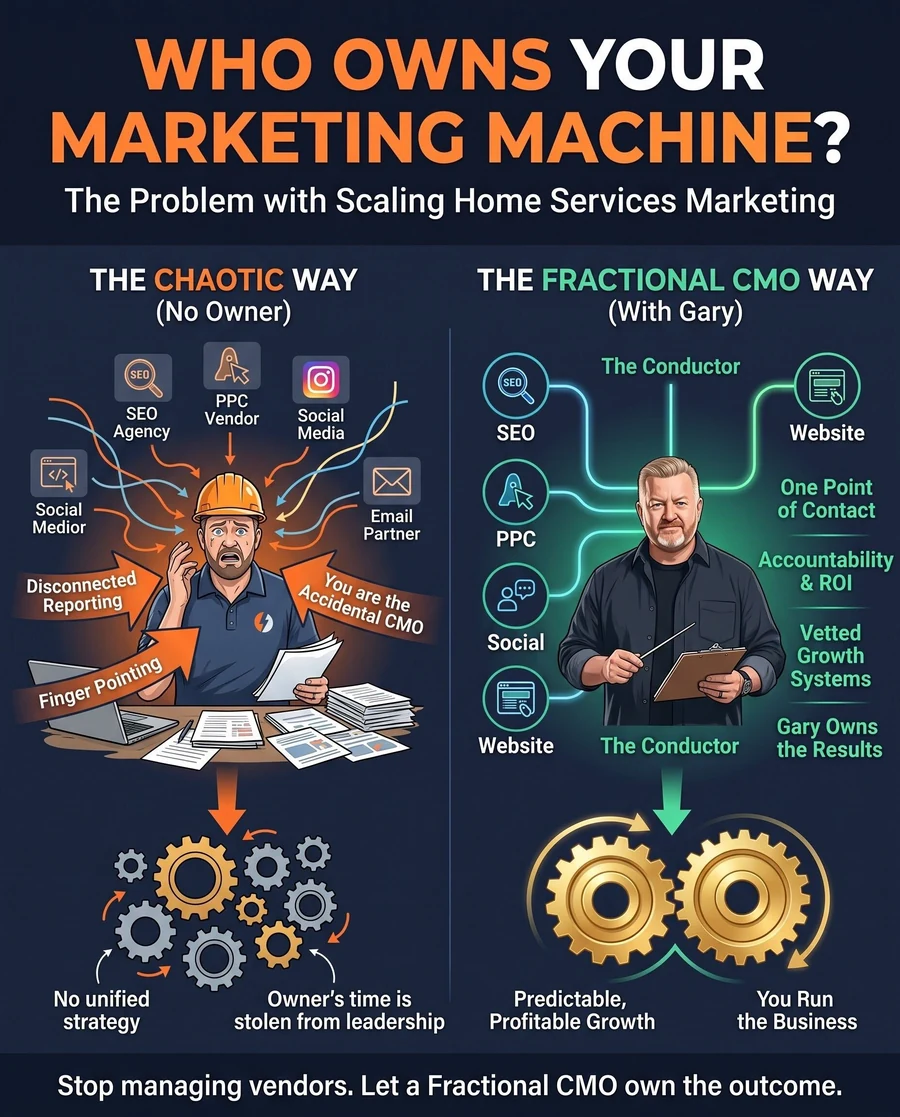
Now you have an SEO company, somebody managing paid ads, another person touching social media, a website company, a CRM, call tracking, email marketing, Local Services Ads and a handful of dashboards that all seem to tell a slightly different story.
Every vendor sends a report showing the work they’re doing. Everyone appears busy. Money is being spent. Leads are coming in. Yet the owner or CEO is still left trying to answer the most important question:
Is all of this actually working together to grow the business?
That’s where the real problem begins.
You don’t necessarily need another vendor. You don’t need another marketing tactic. You need somebody to own the entire marketing machine.
That is the strongest argument for a Fractional CMO.
The Problem Isn’t Finding Marketing People
There are plenty of marketing people. Finding the RIGHT marketing person is a completely different story.
Most owners who have tried hiring a senior marketing person already understand the pain. You write the job description. You post the position. You get 150 resumes. Half of them sound exactly the same.
Everyone is a “data-driven growth marketer” who is “passionate about building brands” and has apparently “scaled revenue” everywhere they have ever worked.
Great. Now figure out which one can actually help run marketing for YOUR business.
Someone may understand branding but know very little about lead generation. Someone else understands paid advertising but has never managed a sales process. Another person might be great at marketing strategy but has never dealt with a home service business where phones have to be answered, estimates have to be sold and trucks have to stay busy.
Then you finally hire someone. Now the learning starts. They need to understand your company, customers, services, margins, sales process, vendors, technology, market, competitors, goals and all the mistakes you’ve already made getting to this point.
You may spend six months discovering whether you’ve hired the right person. If you haven’t? You get to start over.
Hiring senior-level marketing leadership isn’t impossible. It’s just difficult, expensive and risky.
So Owners Try the Other Option: Vendors
Instead of hiring one expensive senior marketing leader, many growing companies build marketing through specialists. That can make a lot of sense.
Hire a great SEO company. Find an amazing PPC company. Bring in somebody who understands social media. Use another vendor for email. Hire somebody else to build the website.
In theory, you’ve assembled the marketing Dream Team. There’s only one problem.
Getting five separate vendors to consistently perform at 110% while also communicating, cooperating and working toward the exact same company objective is about as easy as finding the perfect CMO. Maybe harder.
Every vendor has different people, priorities, processes and definitions of success. Your SEO company is celebrating organic traffic. Your advertising company is celebrating lower cost per lead. Your social media person is celebrating engagement.
Meanwhile, you’re looking at the bank account asking: Did we actually grow revenue?
That disconnect is the problem.
Even Great Vendors Only Own Their Piece
This isn’t an attack on agencies or vendors. Great vendors can completely change a company. The problem is expecting them to do something they weren’t hired to do.
Your SEO company owns SEO. Your PPC company owns advertising. Your website company owns the website. Your social media company owns content. They don’t own your business. And they shouldn’t.
Imagine hiring five amazing subcontractors to build a house but nobody is managing the project. The electrician does great electrical work. The plumber does great plumbing. The roofer installs a beautiful roof.
Unfortunately, nobody noticed that the plumber needed something completed before the electrician closed a wall. Everybody performed their job. The project still became a mess.
Marketing works exactly the same way. You can have great vendors and still have bad marketing because nobody is responsible for making all the pieces work together.
This Is Where Owners Get Trapped
The owner becomes the person filling the gap.
Now you’re reviewing SEO reports. You’re sitting in paid media meetings. You’re asking why Facebook leads don’t close. You’re chasing someone about the website. You’re trying to figure out why the CRM numbers don’t match call tracking. You’re listening to one vendor blame another vendor. Then you’re deciding where next month’s budget should go.
Congratulations. You accidentally became the CMO. Except you still have another job. You have a company to run.
This is where marketing begins stealing time from leadership instead of supporting it.
The CEO should certainly understand marketing. The CEO should be deeply involved in company strategy. But should the person responsible for running a $5 million, $10 million or $20 million home service company be spending Tuesday afternoon trying to determine why Google Ads and the CRM disagree on conversion numbers? Probably not.
The Answer Usually Isn’t Another Marketing Tactic
This is the mistake companies make next. Marketing isn’t performing the way they want, so they add something.
Let’s do TikTok. Let’s rebuild the website. Let’s hire a different SEO company. Let’s spend more on Google. Let’s start direct mail. Let’s hire someone to make videos.
Sometimes one of those ideas is exactly what the company needs. But without someone directing the entire strategy, you are simply adding another instrument to an orchestra that doesn’t have a conductor.
Eventually you get more activity, more reports, more invoices and more confusion. The answer isn’t always more marketing. Sometimes the answer is better leadership of the marketing you already have.
Someone Has to Own the Entire Marketing Machine
This is what a CMO is supposed to do. Not post on Facebook. Not adjust Google Ads. Not write every email. Not redesign every landing page.
A CMO should understand where the company wants to go and build the marketing strategy required to help get it there.
If the business wants to grow from $5 million to $8 million, somebody needs to reverse engineer what marketing has to produce. How much revenue should come from existing customers? How much needs to come from new customers? Which services should grow? Which markets offer the best opportunity? How many leads will sales need? What close rate is required? What can the company afford to spend acquiring a customer? Which marketing channels can realistically produce those customers?
Now your marketing activities have a purpose. Instead of saying we need more leads, you’re saying:
We need 250 qualified leads per month for this service in these markets, at an acquisition cost that allows us to hit this revenue and margin target.
That’s a completely different conversation.
So Why a Fractional CMO?
Most people immediately go to cost. A Fractional CMO is less expensive than hiring a full-time CMO. Sure. That’s a benefit. But I don’t believe it’s THE reason to hire one.
The reason is that many growing home service companies need someone to own marketing before they need another full-time executive on payroll.
They need experience. They need direction. They need someone who can challenge the agencies. They need someone who understands the numbers. They need somebody connecting marketing to sales and revenue. They need someone who can walk into the mess, figure out what matters and begin organizing it.
What they may not need is another executive sitting in the office 45 or 50 hours every week. A Fractional CMO fills that gap.
Experience Matters Because You’ve Already Paid for Enough Learning
Growing businesses usually have scars. You hired the agency that promised the world. You rebuilt the website that didn’t change anything. You hired the employee who interviewed incredibly well and wasn’t nearly as good once the job started. You invested in software everyone was excited about for three weeks and nobody uses now. You’ve probably paid plenty of tuition already.
An experienced Fractional CMO should bring pattern recognition into the company. They’ve seen disconnected reporting. They’ve dealt with underperforming vendors. They understand attribution problems. They’ve watched sales teams mishandle good leads. They’ve seen companies spend more money trying to solve problems that weren’t actually marketing problems.
That experience allows them to begin asking better questions much faster. Where is revenue coming from? What is a customer worth? Which services have the best margins? What is the close rate? How quickly are leads contacted? Where are leads being lost? Which vendors are actually producing? Where should the next marketing dollar go?
Those questions are much more important than asking whether you should post four or five times per week.
Your Fractional CMO Should Sit on Your Side of the Table
This might be the most important difference. Vendors sit across the table. Your Fractional CMO sits beside you.
A vendor has a service to protect. That’s natural. The SEO company believes SEO matters. The advertising company believes advertising matters. The social company believes content matters.
Your Fractional CMO should only care about one thing: what is best for the company?
Sometimes that means telling the advertising vendor you’re crushing it, we’re increasing the budget. Sometimes it means telling the SEO company we’re not seeing enough business impact, what’s changing? And sometimes it means saying we’re shutting this down and moving the money somewhere else.
There should be no emotional attachment to a tactic. The Fractional CMO owns the outcome, not the channel.
Great Marketing Leadership Should Make Vendors Better
One of the biggest misconceptions is that hiring a Fractional CMO means replacing your agencies. Sometimes vendors need replaced. Many times they don’t. Sometimes the problem isn’t the vendor. It’s the lack of direction.
Imagine being an agency and hearing we need more business. Okay. How much? From what services? In what markets? At what customer acquisition cost? What happens to the lead after it arrives? How quickly does sales follow up? What’s the close rate?
Most companies don’t give their agencies that level of direction. Then they get frustrated when the agency doesn’t magically know what success looks like.
A Fractional CMO should make expectations clear. Now the vendor knows what they are responsible for producing and how their work fits into the company’s larger revenue strategy. Good vendors usually thrive under that type of leadership. Poor vendors get exposed quickly. Both outcomes are valuable.
You Stop Depending on Everyone Performing at 110%
This may be the biggest relief. You don’t have to find the perfect marketing employee. You don’t have to somehow assemble five perfect vendors. You don’t need every person involved to perform at 110% every day. That’s unrealistic anyway.
You need a strong system, clear expectations and someone capable of managing the entire thing. Great businesses are not built by hoping every individual part performs perfectly. They’re built by developing systems that continue producing results even when everything isn’t perfect.
The Fractional CMO’s job should be to build that system around your marketing. If one channel struggles, you see it. If one vendor slips, you address it. If lead quality changes, you investigate it. If the sales team isn’t converting, you don’t keep blindly buying more leads.
Someone finally has responsibility for looking at the entire machine instead of waiting for each individual piece to somehow solve the problem.
Eventually You May Want Someone In-House
Fractional doesn’t have to mean forever. As your company continues growing, there may come a point where marketing becomes large and complex enough to require a full-time executive. That’s a good thing.
But think about how different that hire becomes after a Fractional CMO has helped build the foundation. Instead of hiring somebody into chaos, you’re hiring them into an organization with clear reporting, documented processes, established KPIs, accountable vendors, a defined strategy and a team that understands how marketing connects to revenue.
The Fractional CMO can even help define the role, interview candidates and transition leadership to the new person. You’re no longer searching for a unicorn to save marketing. You’re hiring someone to operate and improve a machine that already works.
So Who Owns Your Marketing Today?
That’s the question every growing home service owner should answer. Who decides where marketing dollars are invested? Who connects marketing to sales? Who holds every vendor accountable? Who knows your real customer acquisition cost? Who determines whether you need more leads or simply need to convert more of the leads you already have? Who builds the marketing plan around where the company wants to be two years from now? Who owns the number?
If the answer to most of those questions is you, and you’re also the owner or CEO, you’ve identified the problem. If the answer is spread across four agencies and three employees, you’ve identified another problem.
At some point, marketing needs an owner. Not someone who owns one channel. Not someone who manages one vendor. Someone who owns the entire machine.
That could eventually be a full-time CMO. For many growing home service companies, a Fractional CMO fills that role at exactly the point where the company needs executive marketing leadership but isn’t ready, willing or able to gamble on finding the perfect full-time hire.
The lower cost is nice. The faster start is valuable. The experience matters. But none of those are the biggest reasons. The biggest reason is much simpler: somebody finally owns marketing.
You own the company. Your managers own operations. Your sales team owns sales. Your vendors own their individual services. Your Fractional CMO owns making all of those marketing pieces work together to create predictable, profitable growth.
That’s the job.
If you want someone to own the outcome for your company, see how our Fractional CMO service works and explore our home services marketing resources. You can also book a strategy call to talk through where the opportunity is in your market.