 Call us now:

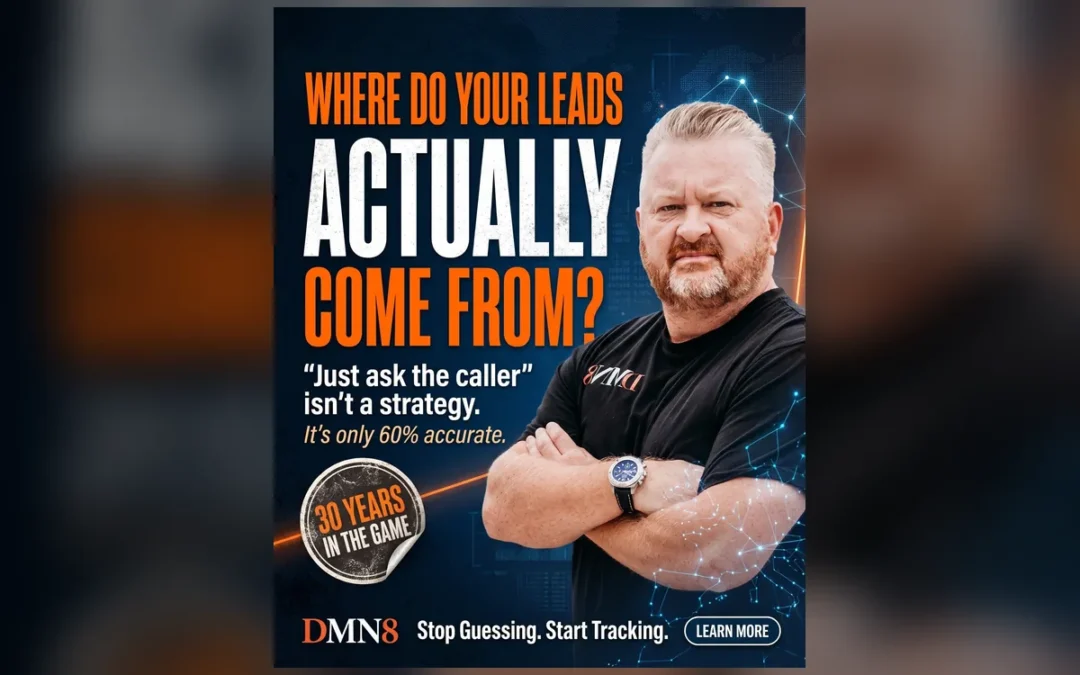
You track where your leads come from by assigning a unique phone number and tracking parameter to every marketing source, recording the calls, and tying each one back to the closed sale in a CRM. Asking the customer does not work. After 30 years of owning and operating businesses, I can tell you that relying on customer memory is about 60 to 70 percent accurate on a good day.
Here is why that gap costs you money, and what to do about it.
Why Asking the Customer Does Not Work
Ask a room full of business owners how they track leads and someone in the back will say, “Just ask the caller.”
Okay, Sherlock. That sounds great in theory.
The problem is that the modern buyer’s journey is a mess. A prospect sees your wrapped truck on the highway. Two days later they ask a neighbor for a referral. Then they search your brand name on Google to find your phone number.
When your intake rep asks how they heard about you, the caller says “Google.”
Just like that, your truck wrap and your word-of-mouth get zero credit, and your digital budget takes a victory lap it has not entirely earned. That broken feedback loop leads to misallocated budgets, wasted spend, and a real misunderstanding of what actually drives your revenue.
Why Marketing Attribution Breaks in a Patchwork Tech Stack
You can try to solve this with software. Standard call tracking, form tracking, GA4, 90210, blah blah blah. Even then, the gaps are massive.
What about your referrals? Are you putting tracking numbers on your trucks, your yard signs, every online directory, and on and on and on kind of like this non-AI written run-on sentence? (Mrs. Miller, my old English teacher, is rolling over in her grave at that one.)
Piecing attribution together across five platforms creates a fragmented, exhausting tech stack. A spreadsheet for Google Ads. A dashboard for your website. A separate login for your phone system. A CRM that barely speaks to any of them.
You end up spending more time asking whether the data is accurate than using it to make decisions.
The real problem is end-to-end attribution. How do you track it without driving your operations team insane? And once you know where the call came from, how do you use those calls to improve conversion?
Because knowing where a lead came from does not matter if your team fumbles on the one-yard line.
Why We Built Our Own Call Tracking and Attribution Platform
After years of patchworking tools together and dealing with API limits, broken integrations and clunky interfaces, we got tired of it. The industry was missing a unified system that closed the loop between the marketing source, the incoming call, the intake process and the final sale.
So we built it ourselves.
That is what AI is actually for. Solving complex operational problems, processing large amounts of data, and surfacing insights humans do not have the bandwidth to find. We could have used AI to make really cool flyers that look exactly like every other company’s flyers. We chose to build a revenue machine instead.
Phone Service, Routing and Call Waiting
This is not a tracking layer sitting on top of your existing provider. It is your phone service. Clear routing, professional call waiting, and seamless transfers, so a customer’s first interaction with your brand is clean.
Call Tracking and Form Tracking for Every Source
We assign dynamic tracking to every source, online and offline. Whether a lead fills out a web form at 2 a.m. or calls a tracking number from a direct mail piece, you know which campaign, which keyword, and which dollar produced that opportunity.
Call Recording, Transcription and Automated Reports
Every interaction is recorded and transcribed. We do not dump audio files on a server for you to ignore. The platform writes an automated report covering the outcome, the caller’s sentiment, and the services they asked about. You get the summary without listening to 45 minutes of audio.
Intake Scripting and Sales Training From Real Calls
This is where attribution turns into conversion.
The platform gives your intake team dynamic scripting, so they ask the right questions and handle objections based on the campaign the caller came from. It also analyzes calls and returns targeted feedback. You can see exactly which reps are closing and which ones need help.
Real-Time Cost Per Lead and ROI Reporting
No waiting until month end to find out whether a campaign worked. The dashboards show cost per lead, conversion rate and marketing ROI as it happens.
Closing the Loop With CRM Integration
A standalone tool is still just a tool. The value shows up when the data connects to your bottom line.
With a connected CRM, the loop closes completely. The marketing source ties to the call. The call ties to the lead record. The lead ties to the appointment. The appointment ties to closed-won revenue.
Now any owner can diagnose a problem in close to real time. If a Google Ads campaign produces a lot of calls and no revenue, you dive in immediately. Lead quality problem? Listen to the recordings. Sales training problem? Read the intake transcripts.
You find the friction point before you waste another dollar.
Every call. Every lead. Every time.
How a Fractional CMO Uses Attribution Data
We did not build this software to sell software. We built it because it is the tool we needed to get results for clients.
At DMN8 Partners this platform is one piece of our Fractional CMO service.
When you hire a fractional CMO you are not hiring a consultant to hand you abstract advice and a nice deck. You are bringing on an executive who takes ownership of your revenue cycle, from brand positioning down to how your front desk answers the phone.
Most agencies run your ads, send a report full of impressions and clicks, and wash their hands of what happens next. If sales are down, they blame your sales team.
We do not point fingers. We fix the process. We track the leads we generate, use the call recordings to train your staff, and use the CRM data to tune the whole machine. Marketing, sales and operations pointed at one number: profitable growth.
The same thinking drives our marketing automation work and how we measure Google Maps ranking performance. Every channel gets held to revenue, not activity.
Frequently Asked Questions
How do you track where leads come from?
Assign a unique tracking phone number and a tracking parameter to every marketing source, online and offline. Record the calls, transcribe them, and tie each lead back to the closed sale in a CRM. That gives you the source, campaign, keyword and outcome for every opportunity.
Is asking customers how they heard about you accurate?
No. It runs about 60 to 70 percent accurate at best. The buyer’s journey crosses several touchpoints and the customer usually names the last one. Offline marketing and referrals get no credit while digital takes credit it has not fully earned.
What is call tracking?
Call tracking assigns a different phone number to each marketing source so every inbound call is attributed to the campaign that produced it. Dynamic numbers do the same for website visitors, matching the call to the keyword and ad that brought them in.
Does marketing attribution help close more deals?
Only if you use the calls. Attribution tells you which campaign produced the lead. Recording and reviewing those calls tells you why the lead did or did not convert, which is where most of the revenue is actually lost.
What does a fractional CMO do with attribution data?
A fractional CMO owns the full revenue cycle rather than just the campaigns. That means using attribution to move spend, using call recordings to coach the intake team, and using CRM data to connect marketing spend to closed revenue.
Stop Guessing Where Your Leads Come From
A 60 percent accurate “just ask the caller” strategy is a recipe for stagnation. Patchworking cheap tools together is a recipe for burnout.
You need a system that captures every data point, trains your team to convert those points into customers, and gives you visibility into the whole process.
If your current marketing is not actively increasing revenue, providing clear attribution and improving your revenue cycle, you are leaving money on the table.
Talk to our team about how our Fractional CMO service and custom technology can change how your business grows.
Go DMN8!